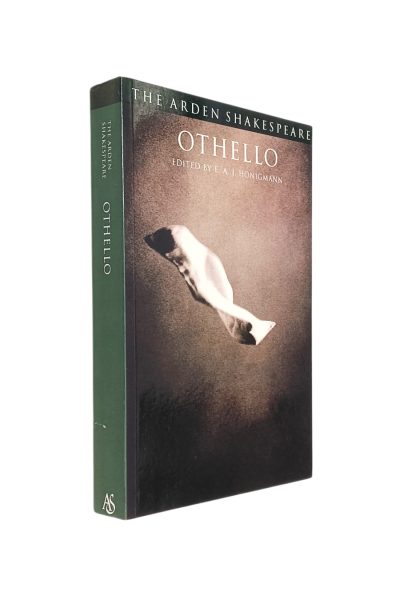
In a period of ten years, Shakespeare wrote a series of tragedies that established him, by universal consent, in the front rank of the world’s dramatists. Critics have praised either Hamlet or King Lear as the greatest of these; Ernst Honigmann, in the most significant edition of the play for a generation, asks: why not Othello? The third of the mature tragedies, it contains, as Honigmann persuasively demonstrates, perhaps the best plot, two of Shakespeare’s most original characters, the most powerful scene in any of the plays and poetry second to none. Honigmann’s cogent and closely argued introduction outlines the reasons both for a reluctance to recognize the greatness of Othello and for the case against the play.This edition sheds new light on the text of the play as we have come to know it, and on our knowledge of its early history. Honigmann examines the major critical issues, the play in performance and the relationship between reading it and seeing it. He also explores topics such as its date, sources and the conundrum of ‘double time’.’Honigmann’s extensive knowledge illuminates this play at every turn, making this the best edition of Othello now available.’ Brian Vickers, Review of English Studies
As You Like It de William Shakespeare. The Arden Shakespeare. UK, 1997, 135 págs.
Readers and audiences have long greeted As You Like It with delight. Its characters are brilliant conversationalists, including the princesses Rosalind and Celia and their Fool, Touchstone. Soon after Rosalind and Orlando meet and fall in love, the princesses and Touchstone go into exile in the Forest of Arden, where they find new conversational partners. Duke Frederick, younger brother to Duke Senior, has overthrown his brother and forced him to live homeless in the forest with his courtiers, including the cynical Jaques. Orlando, whose older brother Oliver plotted his death, has fled there, too. Recent scholars have also grounded the play in the issues of its time. These include primogeniture, passing property from a father to his oldest son. As You Like It depicts intense conflict between brothers, exposing the human suffering that primogeniture entails. Another perspective concerns cross-dressing. Most of Orlando’s courtship of Rosalind takes place while Rosalind is disguised as a man, “Ganymede.” At her urging, Orlando pretends that Ganymede is his beloved Rosalind. But as the epilogue reveals, the sixteenth-century actor playing Rosalind was male, following the practice of the time. In other words, a boy played a girl playing a boy pretending to be a girl.
Para proporcionarmos a melhor experiência possível, utilizamos tecnologias como cookies para armazenar e aceder a informações do dispositivo. O consentimento permite-nos processar dados como o comportamento de navegação ou identificadores únicos neste sítio. Não consentir, ou retirar o consentimento, pode afectar negativamente certas funcionalidades.
Funcional
Sempre ativo
O armazenamento ou acesso técnico é estritamente necessário para o fim legítimo de permitir a utilização de um serviço expressamente solicitado pelo assinante ou utilizador, ou para o fim exclusivo de efectuar a transmissão de uma comunicação numa rede de comunicações electrónicas.
Preferências
O armazenamento ou acesso técnico é necessário para o propósito legítimo de armazenamento de preferências não solicitadas pelo assinante ou utilizador.
Estatísticas
O armazenamento ou acesso técnico utilizado exclusivamente para fins estatísticos anónimos. Sem uma intimação, sem a colaboração voluntária do seu fornecedor de serviços de Internet, ou sem registos adicionais de terceiros, a informação armazenada ou recuperada apenas para este fim não permite, em geral, identificá-lo.O armazenamento técnico ou acesso que é usado exclusivamente para fins estatísticos anónimos. Sem uma intimação, conformidade voluntária por parte do seu Fornecedor de Serviços de Internet ou registos adicionais de terceiros, as informações armazenadas ou recuperadas apenas para esse fim geralmente não podem ser usadas para identificá-lo.
Marketing
O armazenamento ou acesso técnico necessário para criar perfis de utilizador, enviar publicidade ou rastrear o utilizador num ou em vários sítios para fins de marketing.